
.png)



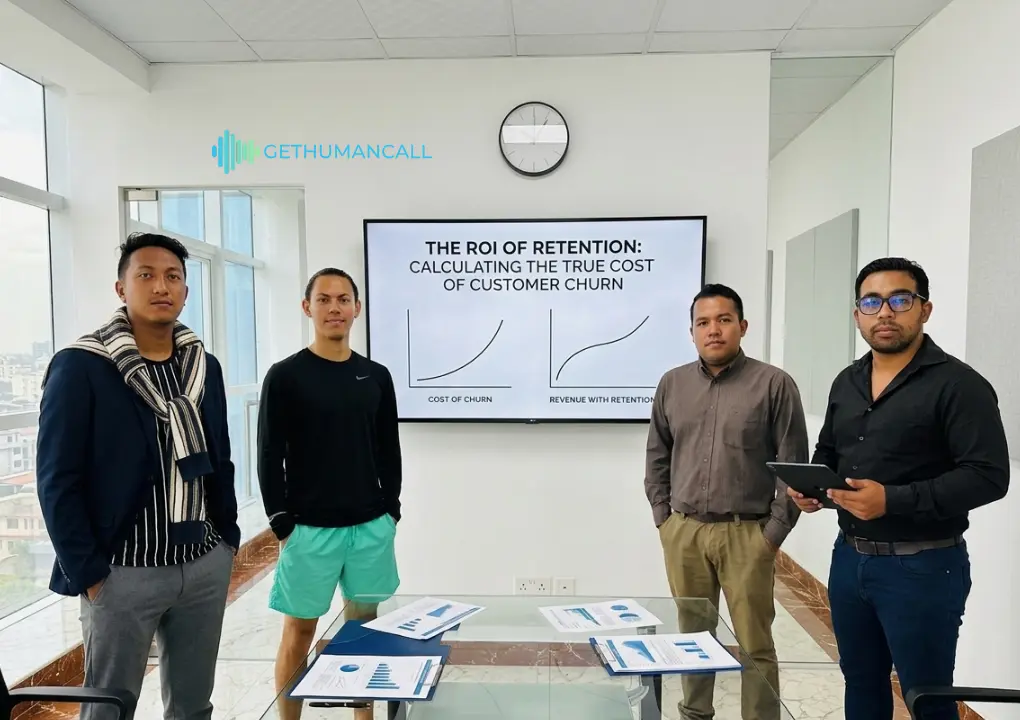
The ROI of Retention: Calculating the True Cost of Customer Churn
Most businesses know that losing customers is costly. Few have actually calculated how costly.
Customer churn quietly erodes revenue, inflates acquisition budgets, and suppresses long-term growth — often without triggering a single alert on a leadership dashboard. It is one of the most financially significant dynamics in business, and one of the most systematically underestimated.
This article breaks down the true cost of churn, provides a practical framework for calculating your retention ROI, and outlines the strategies that consistently move the needle. Whether you lead a marketing function, a customer experience team, or a P&L, the numbers here will reframe how you think about retention — not as a support objective, but as a core growth strategy.
And at the centre of that strategy sits one often-overlooked asset: the quality of your customer service interactions.
Why Retention Is the Most Undervalued Growth Lever in Business
Every quarter, finance teams scrutinise acquisition costs, campaign performance, and new revenue pipelines. Yet one number quietly bleeds the bottom line without appearing on any growth dashboard: the cost of losing customers you already have.
Customer retention is not a support metric. It is a revenue strategy — and for most businesses, it remains the most underutilised one available.
The logic is deceptively simple. Acquiring a new customer costs five to seven times more than keeping an existing one. A retained customer spends more over time, refers others, and generates revenue with far lower marginal cost. Yet the majority of growth budgets still skew heavily toward acquisition. The result? Companies sprint to fill a leaking bucket rather than fix the hole.
Before any retention strategy can be built with confidence, one question has to be answered with precision: what is customer churn actually costing you? Understanding the financial impact of customer dissatisfaction is where that calculation begins — and where the business case for retention investment becomes impossible to ignore.
The True Cost of Churn: Beyond the Lost Invoice
Most businesses measure churn in its most visible form — a cancelled subscription, a lapsed account, a client who doesn't renew. That number is real, but it is only the surface layer. The full financial cost of losing a customer runs significantly deeper, across four distinct dimensions that are rarely captured together.
Lost Lifetime Value: The Revenue You'll Never See
Lost Lifetime Value (LTV) is the most immediate calculation. When a customer churns, you don't lose one month of revenue — you lose every future transaction they would have made. For a customer with a five-year average tenure and a £200 monthly spend, a single churn event represents £12,000 in lost future revenue. That figure rarely appears on a churn report. It should.
The Hidden Cost of Replacing What You Already Had
Replacement acquisition cost compounds that loss. Filling the gap left by a churned customer requires marketing spend, sales effort, onboarding resources, and time — all deployed to recover ground you already held. Research consistently places the cost of acquiring a new customer at five to seven times the cost of retention. In competitive markets, that multiplier can be higher.
Referral Erosion and Brand Damage
Referral erosion is the cost most often left out of churn calculations entirely. Retained customers refer others. Churned customers do the opposite. In markets where peer recommendations drive purchasing decisions — which is most markets — a churned customer doesn't just stop spending. They actively reduce future revenue by dampening the pipeline they would otherwise have fed. In the age of public reviews and social media, that damage can extend far beyond a single lost account.
Complaint Overhead and Operational Drag
Complaint and escalation overhead adds further operational cost. The weeks or months before a customer churns are typically marked by unresolved friction — repeated contacts, escalations, and management time spent on cases that could have been prevented. That labour has a measurable cost, even before the account is formally lost.
Add these layers together and the true cost of a single churned customer is almost always two to three times the headline revenue figure. At scale, the gap between perceived churn cost and actual churn cost can represent a critical misallocation of strategic resources.
Calculating Your Retention ROI: A Practical Framework
Understanding churn cost in the abstract is useful. Having a model specific to your business is what drives decisions. A straightforward retention ROI framework works in four clear steps.
Step 1 — Establish Your Average Customer Lifetime Value (CLV)
Divide your total revenue over a defined period by the number of customers, then multiply by your average customer tenure. This gives you the baseline revenue value of a retained customer relationship — the number everything else anchors to.
Step 2 — Apply Your Current Churn Rate
If 10% of your customer base churns annually and your CLV is £5,000, you are losing £500 per customer in your base each year — before replacement costs are factored in. At 2,000 customers, that is £1,000,000 in annual revenue exposure from churn alone.
Step 3 — Isolate Dissatisfaction-Driven Churn
Not all churn is preventable. Customers leave for budget reasons, structural changes, or circumstances outside your control. But industry data consistently shows that 60 to 70% of churn is experience-driven — meaning it was avoidable. Applying that percentage to your churn rate tells you what is genuinely at risk and what investment in retention can realistically recover.
Step 4 — Model the Impact of Marginal Retention Improvement
A 5% improvement in retention rate sounds modest. Across a customer base of 2,000 accounts with a £5,000 CLV, it represents £500,000 in protected annual revenue. That figure, compared against the cost of a retention programme, produces a clear and defensible ROI — one that most businesses find compelling when they run it for the first time.
Building a Retention Strategy That Delivers Measurable Results
Knowing the cost of churn creates urgency. Building a strategy that addresses it requires focus on the mechanisms that actually move retention rates. Here are the five levers that consistently deliver results.
- Identify churn signals early. The customers most at risk of leaving rarely announce it. They disengage gradually — fewer logins, slower responses, reduced usage, declining NPS scores. Building early-warning systems that surface these signals allows intervention before churn becomes inevitable.
- Close the experience gap. The most consistent driver of avoidable churn is a gap between what customers were promised and what they actually receive. Structured Voice of the Customer programmes, journey mapping, and direct feedback identify where loyalty is eroding — and why.
- Invest disproportionately in high-value accounts. A tiered retention approach that deploys deeper relationship management, dedicated support, and proactive engagement for your most valuable segments protects the revenue that matters most. Human-led account management at this tier is not a cost — it is a retention mechanism with a calculable return.
- Invest in service recovery as a competency. When an issue is handled with speed, empathy and genuine ownership, a dissatisfied customer can become one of your most loyal.
- Track retention KPIs alongside revenue KPIs. Retention rate, Net Promoter Score, Customer Effort Score, and cohort-level churn analysis should sit alongside revenue and acquisition metrics in every leadership review. What gets measured gets managed.
The Call Centre Advantage: How Human Support Directly Drives Retention
Retention strategies fail when they remain theoretical. The moment a customer picks up the phone — frustrated, confused, or on the verge of leaving — the quality of that interaction determines whether they stay or churn. That is where a well-structured call centre operation becomes one of the most direct and measurable retention levers available.
Every Call Is a Retention Moment
Most businesses treat inbound calls as a cost to minimise. The most retention-focused organisations treat them as opportunities to reinforce loyalty. When a customer contacts support, they are signalling engagement — they haven't left yet. A skilled human agent who resolves their issue with speed, empathy, and ownership converts that moment of friction into a reason to stay.
Research consistently shows that a complaint handled exceptionally well produces higher loyalty than no complaint at all. That dynamic only activates through genuine human connection — and building the organisational capability to deliver it consistently is one of the highest-leverage retention investments available.What Separates a Retention-Focused Call Centre From a Standard One
Not all call centre operations are built with retention in mind. The difference lies in several key areas:
- First Contact Resolution (FCR): Every time a customer has to call back about the same issue, their likelihood of churning increases. A retention-focused operation is built around resolving issues completely on the first interaction — reducing frustration and operational cost simultaneously.
- Agent empowerment: Agents who lack the authority to offer solutions, process refunds, or escalate intelligently create friction. Empowered agents close cases. Disempowered agents accelerate churn.
- Tone and emotional intelligence: Particularly for high-value or long-tenure customers, the emotional quality of an interaction matters as much as its outcome. A customer who feels genuinely heard is far less likely to leave than one who feels processed.
- Proactive outreach: The most effective retention calls are the ones that happen before a customer considers leaving — check-ins, renewal conversations, post-issue follow-ups. Proactive contact signals that the relationship matters beyond the transaction.
The Financial Case for Investing in Human Support
Automating customer interactions reduces cost per contact. But it also reduces the quality of retention-critical moments. For high-value accounts, long-tenure customers, or clients navigating complex issues, the cost of a failed automated interaction far exceeds the cost of a skilled human agent handling it well. Knowing exactly when to deploy human support — and when automation is sufficient — is itself a strategic decision.
At GetHumanCall, we operate on a clear principle: automation handles volume, humans handle value. The clients most at risk of churning are precisely those who need a knowledgeable, empathetic agent — not a chatbot. Deploying human expertise at those moments is not an overhead. It is a retention investment with a direct and calculable return.
The Compounding Returns of Strong Retention
The compounding effect of strong retention is one of the most powerful dynamics in business economics — and one of the least intuitive until the numbers are laid out clearly.
The Five-Year Divergence That Changes Everything
A business with a 5% annual churn rate retains 95% of its customer base each year. Over five years, that business retains approximately 77% of the customers it started with. A comparable business with a 10% churn rate retains just 59% over the same period. That 18-point gap in customer base represents an enormous divergence in revenue trajectory, brand equity, and enterprise value — all from a difference of five percentage points in annual churn.
Loyalty as a Long-Term Revenue Engine
Retained customers increase their spend as trust deepens. They refer others at higher rates, provide more useful feedback, and cost less to serve as familiarity reduces friction. Loyalty programmes, proactive communication strategies, and structured retention investments compound that advantage over time. The ROI of retention is not a one-time calculation — it is a compounding return on every pound invested in keeping customers who already chose you.
Retention Is a Strategic Priority, Not a Support Function
The businesses that lead on customer retention share a common characteristic: they treat it as a board-level priority, not a customer service objective.
That means building measurement frameworks that surface the true financial cost of churn. It means investing in the talent, technology, and processes that close the experience gaps driving preventable losses. And it means recognising that the customers most worth retaining — high-value, long-tenure accounts navigating complex needs — require human expertise, not automated deflection.
The cost of churn is real, calculable, and in most businesses, significantly higher than current reporting suggests. The opportunity to reverse it is equally real. And for organisations that understand the role of exceptional human support in that equation — the returns are not marginal. They are transformational. At GetHumanCall, we help businesses across the UK, USA and Europe build the customer service infrastructure that makes retention a measurable, manageable, and consistently delivered outcome.
.webp)