



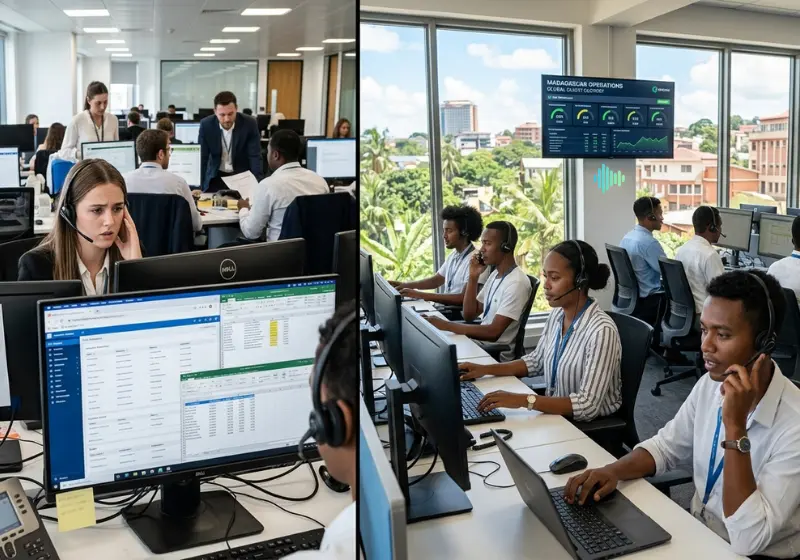
Surging In-House Staff Costs in the UK
As UK employment taxes, minimum wage adjustments, and overhead expenses reach record highs in 2026, the average cost of maintaining a full-time in-house customer service representative in London or Manchester has crossed £35,000 to £42,000 per year. For a growing team, that figure multiplies fast, and it rarely stops at salary alone.
Scale-ups now face a critical dilemma: scale customer service headcount to match growth, or protect the cash margins that keep the business fundable. Neither option is comfortable when done in-house alone.
This is where offshore customer support becomes a genuine strategic option rather than a last resort. Offshoring high-quality support operations to strategic locations, such as Madagascar or other nearshore-adjacent hubs, allows UK companies to cut operational expenditure by up to 60% without sacrificing service quality or native-level English fluency.
The Financial Reality of In-House UK Customer Support in 2026
Before comparing models, it helps to see exactly what an in-house UK agent actually costs once every line item is added up, and where growth starts to strain the model.
Breaking Down the True Cost of a UK Support Agent
The advertised salary is only the starting point. The real cost per agent typically includes:
- Base salary, now pushed upward by wage inflation and competitive hiring markets,
- Employer National Insurance Contributions (NICs), which have risen sharply and add a significant percentage on top of gross pay,
- Pension contributions, mandatory under UK auto-enrolment rules,
- Software licenses, including CRM, helpdesk, QA, and workforce management tools,
- Office overhead, from desk space to utilities, even in hybrid setups.
On top of these fixed costs sits a less visible but equally damaging one: turnover. UK contact centers regularly report high attrition rates, and every departure triggers a new cycle of recruitment fees, onboarding time, and productivity loss while a replacement ramps up.
The Scale-Up Bottleneck
Rapid growth is supposed to be good news, but for a scale-up cost optimization plan built entirely around UK-based hiring, it often becomes the opposite. Support volume grows in line with new customers, yet headcount cannot scale as fast as demand. The result is a familiar bottleneck:
- Recruitment and onboarding cycles of four to eight weeks per hire,
- Overtime costs to cover evenings, weekends, or unexpected spikes,
- Operating margins that shrink exactly when the business is trying to prove it can scale profitably.
In-House vs. Strategic Offshore Support: A Side-by-Side Look
Rather than a dense table, here is a straightforward, side-by-side breakdown of how the two models compare across the metrics that matter most to a scale-up.
Cost per agent, per month
- In-house UK team: High, typically £3,000 or more once NICs, pensions, and overhead are included.
- Strategic offshore team (e.g., GetHumanCall): Low to moderate, up to 60% lower for equivalent coverage.
Coverage capability
- In-house UK team: Standard business hours, with overtime fees required for evenings, weekends, or 24/7 coverage.
- Strategic offshore team: Seamless 24/7 and weekend coverage built into the operating model.
Scalability speed
- In-house UK team: Four to eight weeks to recruit, hire, and onboard a new agent.
- Strategic offshore team: One to two weeks to flex capacity up or down.
Management overhead
- In-house UK team: Requires internal HR, operations, and facilities management.
- Strategic offshore team: Fully managed operations and quality assurance, handled by the provider.
This format makes the trade-off easy to scan: the offshore model consistently wins on cost and speed, while the in-house model retains direct day-to-day control, a point worth weighing honestly rather than glossing over.
Overcoming the Common Offshore Myths
Cost savings only matter if quality and compliance hold up. Two objections come up more than any others, and both deserve a direct answer.
Myth 1: "Quality and Tone Will Suffer"
This concern made sense a decade ago, but it no longer reflects how specialized offshore hubs operate today. Rigorous recruitment processes, cultural alignment training, and native-level or near-native English fluency are now standard practice in serious offshore centers. Agents are trained not just on scripts, but on tone, empathy, and brand voice, so the customer experience feels consistent with what a UK-based team would deliver.
Myth 2: "Data Privacy & Compliance Risks"
Compliance is a legitimate concern, and it should be checked rather than assumed. A credible offshore partner will demonstrate:
- GDPR adherence across data handling and storage,
- ISO certification standards for information security and quality management,
- Secure CRM integrations with encrypted access and audit trails.
Asking a provider to walk through these safeguards before signing a contract is one of the simplest ways to de-risk the decision.
How UK Scale-Ups Should Structure Their Hybrid Offshore Strategy
The most effective approach rarely means replacing a UK team entirely. It means designing a tiered model that plays to each side's strengths.
Tiered Operational Model
- Core and strategic leads: A small internal UK team handles high-level account management, escalations that require deep product knowledge, and relationships with key accounts.
- Volume and operational execution: A managed offshore team handles the bulk of daily customer inquiries, technical tickets, and outbound qualification.
This split keeps strategic control in-house while shifting the cost-heavy, high-volume work to a partner built for it.
Key Steps to Launch an Offshore Team in 30 Days
Getting from decision to live operations does not need to be slow. A well-run launch typically follows:
- Clear SLA (Service Level Agreement) definition covering response times, resolution targets, and escalation paths.
- Structured knowledge base transfer so agents can handle real queries from day one.
- Real-time QA monitoring during the first weeks to catch and correct issues early.
From Cost Pressure to Competitive Advantage
Offshoring is no longer just about cutting costs. For UK scale-ups facing rising NICs, wage pressure, and the operational strain of rapid growth, it has become a strategic growth lever that enables 24/7 agility without the recruitment lag or overhead of building everything in-house.
Ready to scale your UK customer support team efficiently? Contact GetHumanCall today to get a custom cost-saving estimate.